

Leadership
September 13, 2026

Where Executives Find
Their Competitive Edge
The Leader You Become When You Think No One's Watching
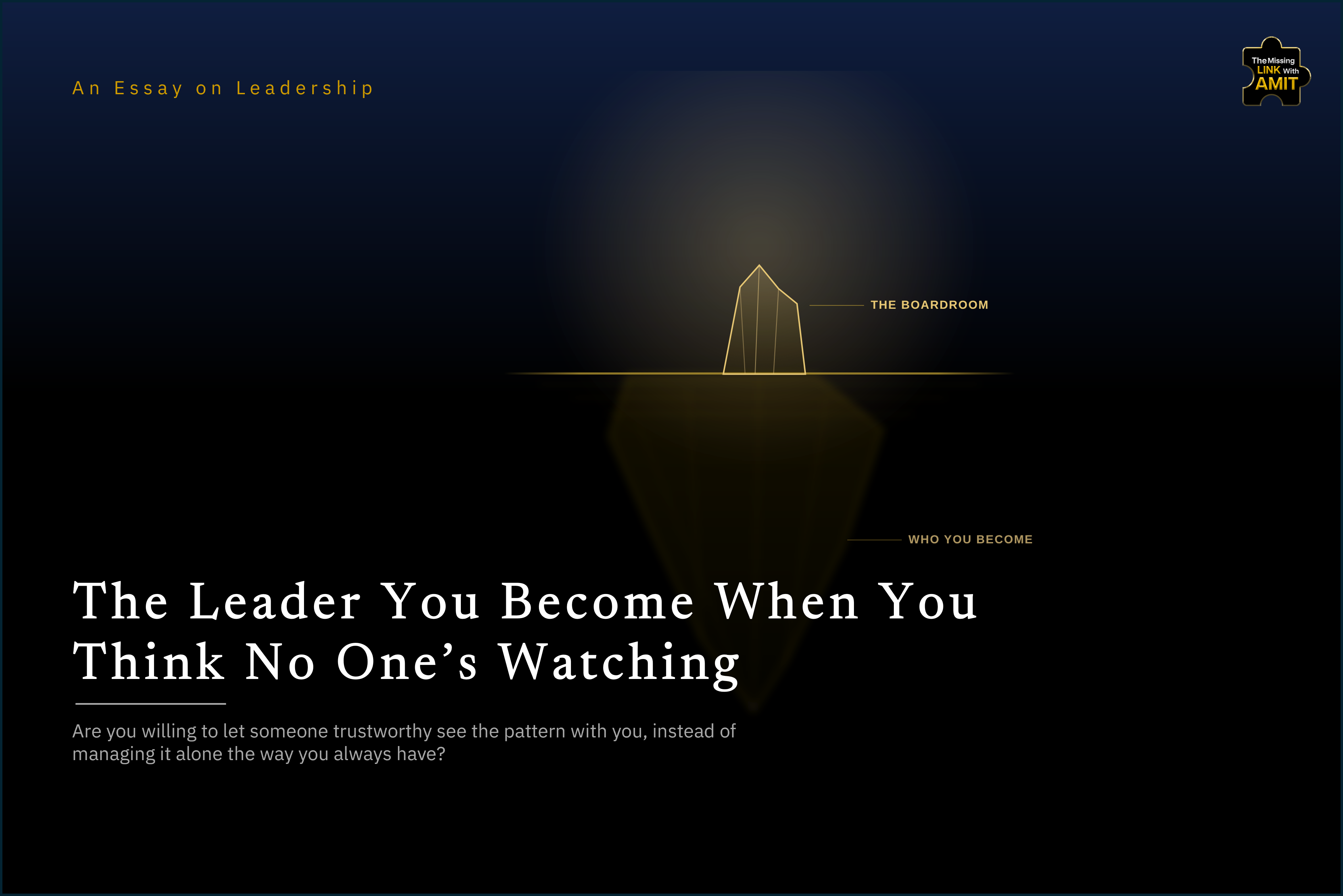
Every leader manages pressure.
The board meeting that didn’t go as planned, the decision that keeps circling back at midnight, the sense that the version of yourself running the show isn’t entirely the one you set out to be. None of that is unusual, and none of it is a flaw. What truly separates a few from the others isn’t whether they carry pressure. It’s what they do with it when they think no one’s watching.
This article is designed as a mirror. Read it as one, and you’ll probably recognise yourself or someone you know very well in the first few paragraphs. Read past that recognition, and you’ll find out why you’re built that way, and what you may choose to do about it now.
Three Ways Pressure Leaks Out
Pressure that isn’t processed doesn’t vanish. It leaks. And in the leaders I’ve worked with, it tends to leak out in three ways (Exhibit 1).
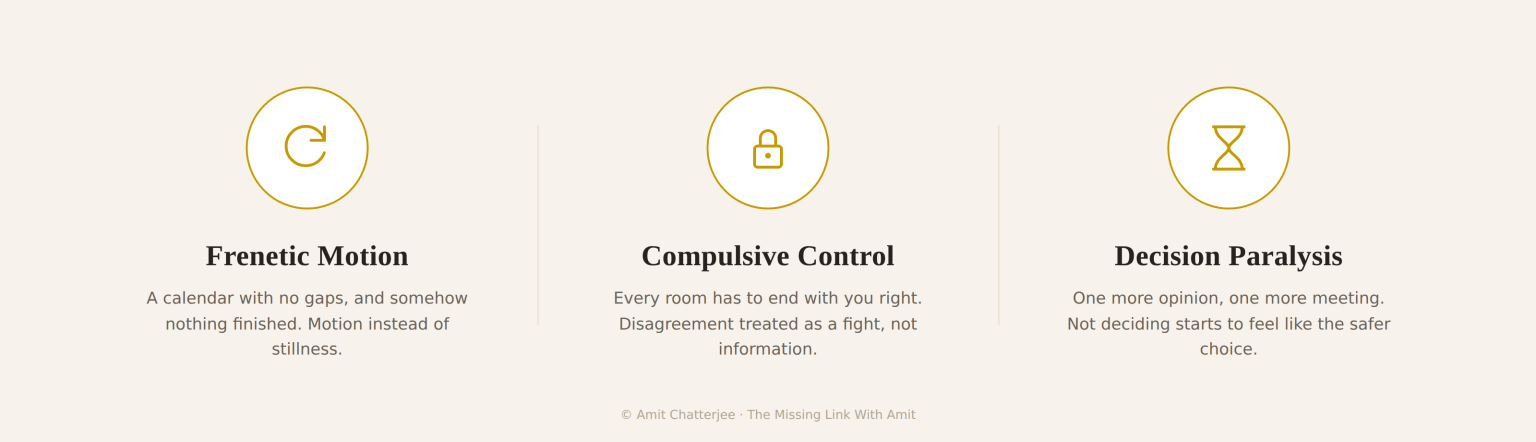
Exhibit 1
Frenetic Motion:
Your calendar has no gaps left in it. Back-to-back meetings, a new initiative every quarter, and somehow the pile of unfinished things that keeps growing rather than shrinking. Onlookers read it as ambition. In practice, it creates the alibi not to notice what’s gnawing at you. You’re worn out by dinnertime. Surely that means you’ve earned something, while you avoided asking what any of it was for. The rationalisation lies in the efforts made, not the results.
Compulsive Control:
You need to be the one who’s proven correct by the time the meeting ends. A dissenting view doesn’t register as useful information. It registers as a conflict to be won. Feedback starts arriving like an attack rather than data, until the people around you stop bothering to offer it at all.
Congratulations. You have achieved perfect silence and mistaken it for consensus.
From a distance this can look like conviction: decisive, fast, in command. It rarely is. It’s pressure that doesn’t have anywhere honest to go, so it goes looking for someone to dominate instead.
Decision Paralysis:
There’s always room for one more meeting before the call gets made, one more opinion to gather before you commit. Sometimes that could be just thoroughness. Past a certain point, though, it quietly turns into a facade of never being seen as wrong in public. Staying undecided starts to feel like the safer option. It isn’t. It’s just a decision wearing a disguise.
Which one did you recognise first? Hold onto it.
The rest of this piece is about where it comes from, and what you can possibly do about it.
Where do these patterns originate from
Our behaviour is motivated by our ungratified needs, said Abraham Maslow (Maslow, 1943). The patterns of Motion, Control, and Paralysis all come from the same place, an ungratified need for acknowledgement, recognition or identity – our narcissistic needs. It is surely connected to our self-esteem, self-belief and emotional balance. How that need gets shaped by our earliest experiences of being seen, or not seen, decides which of these adult patterns it eventually becomes. Psychoanalyst Otto Kernberg described narcissism (Kernberg, 1979) as a perennially ungratified need for power and prestige, a hunger that usually traces back to parenting that was rejecting or simply unresponsive. A child who learns early that the only way to get attention is to fight for it grows into an adult who fights for it still, but in sartorial attire and a bigger office.
The office gets bigger. The child, rarely.
That specific hunger manifests in three ways: sometimes as proving yourself through output, motion; sometimes through dominance, control. And at times as indecision, paralysis – will address that later.
The Narcissism Spectrum:
This pattern rarely announces itself in the boardroom presentation. It shows up on the walk to the car afterwards, in how you speak to your assistant, in the meeting nobody bothers to minute. It is, in the truest sense, who you become when you think no one’s watching.
The good news is that a certain dose of narcissism is necessary to function effectively. Among those who show limited narcissistic tendencies we find those who are very talented and capable of making great contributions to society. Those who gravitate to the reactive extreme, however, give narcissism its pejorative reputation (Kets de Vries & Miller, 1985). Manfred Kets de Vries and Danny Miller mapped the narcissism spectrum decades ago. They named the three dimensions as Reactive, Self-Deceptive, and Constructive narcissism. As a practitioner and later as a coach or an advisor, my own reading of that spectrum, shaped by years of watching it play out in real leadership teams is presented in Exhibit 2. I’ve mapped Frenetic Motion and Compulsive Control to the Reactive profile, Decision Paralysis to the Self-Deceptive one sitting at the midpoint of the spectrum with a wound of its own and kept Constructive as the pattern that does not need much to manage.
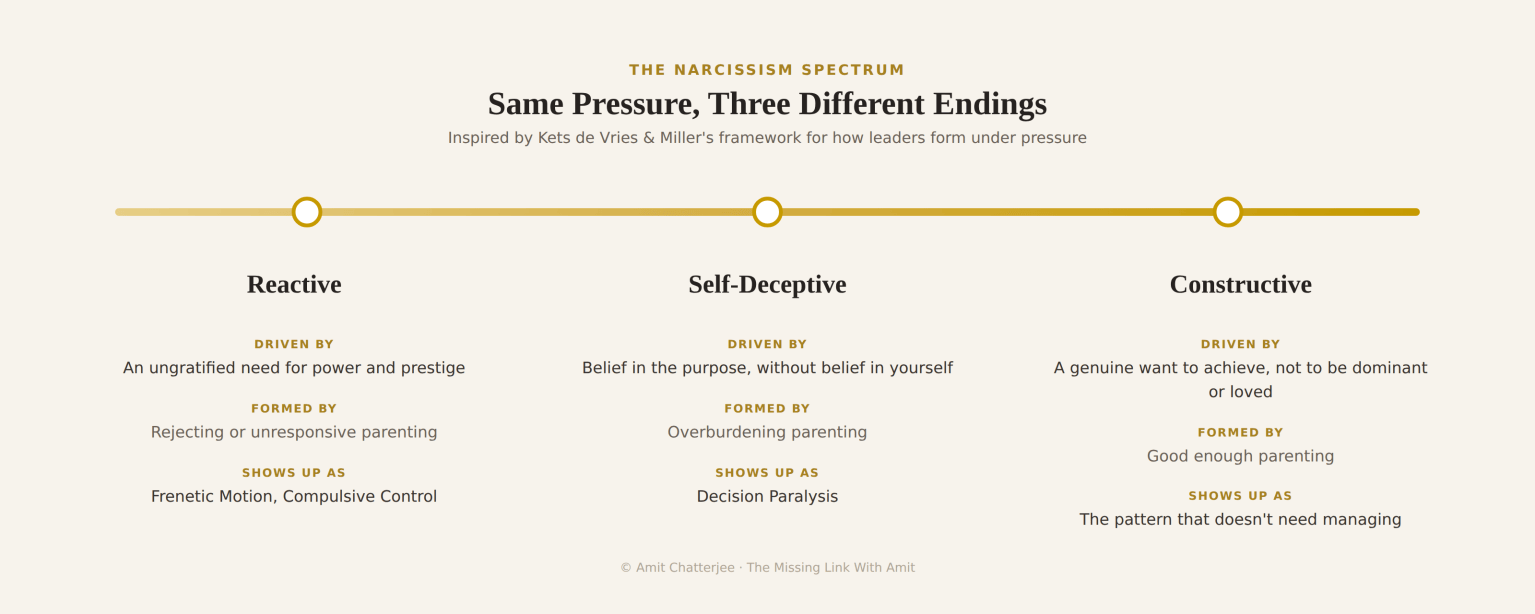
Exhibit 2
The Narcissist’s Sidekick:
Narcissists always recruit a sidekick. Someone close enough, and loyal enough to be useful: a deputy, an aide, sometimes a spouse. Their job, rarely spoken aloud, becomes managing the gap between how things are and how the leader needs to believe they are. They smooth over the disagreement before it reaches you. They agree a little too readily. Without quite meaning to, they feed the exact hunger that’s driving the pattern in the first place.
But there’s a complication worth sitting honestly with (Exhibit 3). Not every sidekick is loyal. Some are extracting position or advantage from proximity to power, and have every incentive to protect that proximity, not you. When a real crisis hits, the kind that can’t be blamed on a rival or explained away, a fox in sheepskin turns rogue, and a genuinely loyal sidekick becomes invaluable.
Aesop tried to warn us about this. We filed it under fiction.

Exhibit 3
The difference between the two is invisible until the crisis forces it into view. But if the loyalty was ever real, this is where it pays off. Markets collapsing rarely stops a Reactive leader. Board revolts get externalised, blamed on politics, survived. What interrupts the pattern is something more personal: a health scare, or unexpected honesty from someone you can’t dismiss as a rival and can’t easily blame. That’s your sidekick’s real value, if you were lucky enough to have a genuine one. Not the shielding. The one moment they stop shielding you and tell you the truth instead.
Where Paralysis Comes From:
Heinz Kohut called it the Ideal-Hungry personality (Kohut, 1977): someone who genuinely believes in the purpose, can talk and write about it fluently, and still can’t act on it. Not from a failure of conviction, but a failure of self-belief resulting in inaction despite your own better judgement. It tends to form through overburdening parenting rather than rejecting parenting. A child taught that compliance and striving hard to meet others’ expectations were the only safe channels, grows into an adult who can’t risk being visibly wrong.
Sadly, in my experience, this leader rarely has a sidekick at all. Grandiosity attracts loyalty, even opportunistic loyalty. Weakness doesn’t. Nobody organises their career around propping up someone who can’t commit to a decision. So, this leader ends up paralysed and structurally alone, with no one positioned closely enough, or invested enough, to ever deliver a moment of honesty the way a genuine sidekick might. That’s a harder problem than the Reactive leader’s, and it needs a different answer.
The Pattern That Doesn’t Need Managing:
The third profile in this spectrum is worth dwelling on properly, because it’s the only one of the three that may not need active managing later in life. Kets de Vries and Miller called it Constructive narcissism: self-confident, ambitious, driven by a genuine want to achieve rather than a hunger to dominate or be loved. It comes from what’s sometimes called good enough parenting, not perfect, not indulgent, just present enough and honest enough that a child’s early successes and failures both got to be real, rather than managed or punished.
I’d encourage you to read this paragraph twice: once as a leader, and once as a parent.
Every time you shield your child from a disappointment they could have survived or demand a version of achievement you needed and they don’t, you’re quietly doing what your own parents may have done to you. Every time you let them fail at something recoverable, and stay present without rescuing or withdrawing, you’re building the one profile in this entire framework that never needs a sidekick, never experiences a fox that shed its sheepskin, and never needs an article like this one. That’s not a small thing to be able to offer someone. Think of it as a vaccine. It’s considerably easier to give than a cure.
What the Research Actually Shows
None of this is only theory. Heike Bruch and the late Sumantra Ghoshal studied thousands of managers (Bruch & Ghoshal, 2002) and mapped them on a grid of energy against focus (Exhibit 4).
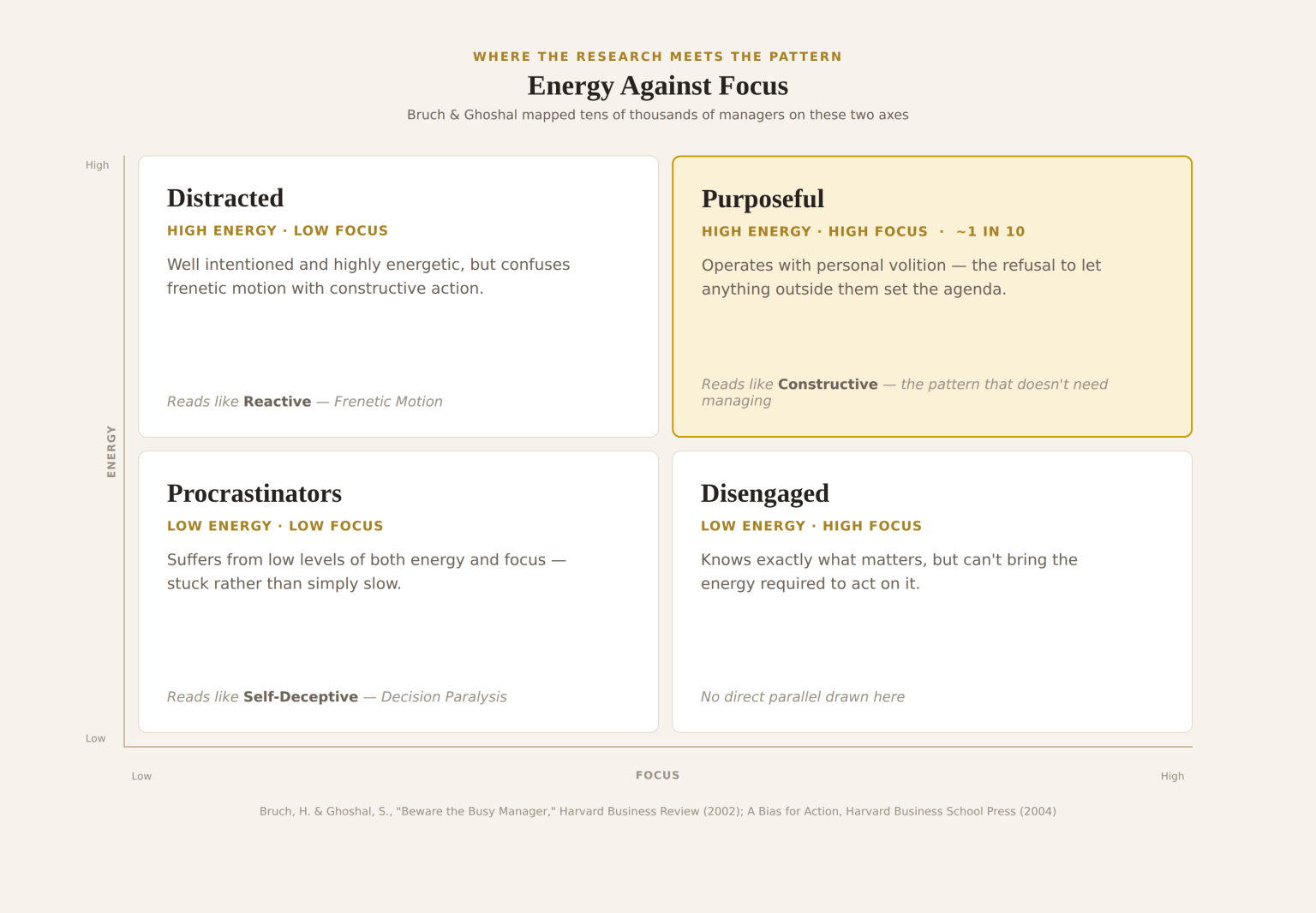
Exhibit 4
Procrastinators, low on both, look a great deal like the Self-Deceptive profile. The Distracted, high energy but no focus, confuse frenetic motion with constructive action, which is Motion by another name. The Purposeful, high on both, operate with what Bruch and Ghoshal called personal volition (Bruch & Ghoshal, 2004): those who chose to refuse anything outside them to set the agenda. Across everyone they studied, about one in ten qualified as volitionally engaged.
Better odds than most mutual funds, if you think about it.
Read that statistic as discouraging and you’ve missed the point of it. Read it as the actual size of the door, not the size of the crowd trying to get through it, and it becomes something closer to a pathway than a verdict.
What It Takes to Come Back
Coming back from any of these patterns isn’t about willpower, and it isn’t about pretending the pattern never existed. In my work, it takes two things, in a specific order (Exhibit 5).
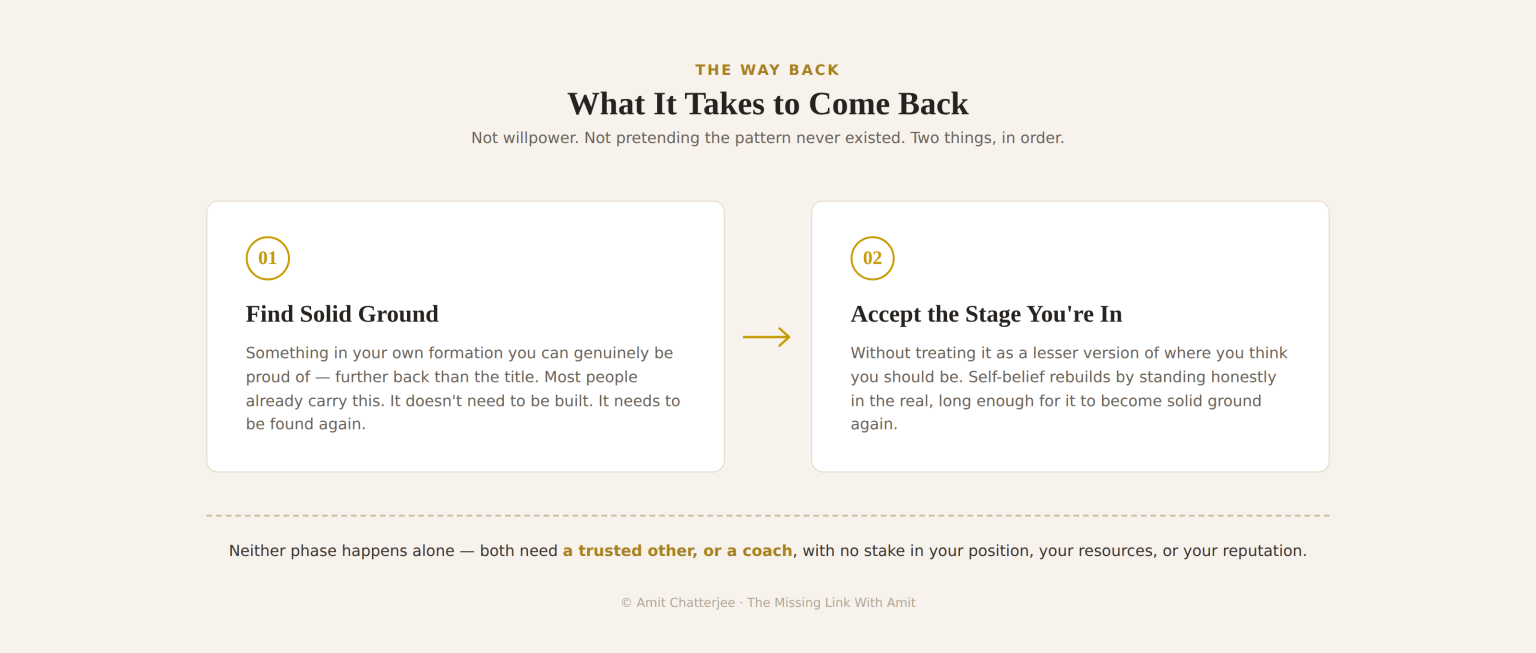
Exhibit 5
The exhibit names both moves, but the order is the real point. Try it the other way round, and you’re not really accepting the stage you’re in. You’re avoiding it, using the language of peace to escape the discomfort of leading, and of growing into a more evolved version of yourself. That’s fatigue clothed as acceptance.
Get the sequence right, and you could be up and running again. This is, in effect, giving yourself the good enough acceptance a Constructive childhood provides automatically, except you’re doing it for yourself, as an adult, deliberately. Self-belief doesn’t get rebuilt by closing the gap between the real and the ideal overnight. It gets rebuilt by standing honestly in the real, long enough for it to become solid ground again.
Neither phase happens alone, and this is the part I want to be direct about.
If you’ve spent years running the Reactive pattern, the sidekick you’ve relied on has mostly stood as a shield between the self you project and the self underneath it. What it takes to come back is someone willing to close that gap instead of guarding it, someone who tells you the truth before a crisis forces the question. If you’ve spent years running the Self-Deceptive pattern, there was likely never anyone in that position at all, which means the trusted other must be found deliberately rather than discovered in a crisis.
This is what it means to use a coach, whether that’s a trusted ally who can step into the role, or someone you engage formally to play it. Not for motivation or inspiration, but to have a relationship with an experienced person who understands you and wants you to be back. A person who has no stake in your position or your resources, but in being there when it matters, giving you what you need rather than what you want, without compromise.
None of the three patterns in this piece is a life sentence, and none of them makes you unusual. Every leader I’ve worked with has run at least one of them before something made them pause and reflect. What decides what happens next isn’t whether you recognised yourself here. It’s whether you’re willing to let someone trustworthy see the pattern with you, instead of managing it alone.
That, and how you influence whoever’s watching you do it, including your own children. You may have spent an entire lifetime thinking no one was watching.
But someone always was.
References
- Maslow, A. H. (1943). A Theory of Human Motivation. Psychological Review, 50(4), 370–396.
- Kohut, H. (1977). The Restoration of the Self. New York: International Universities Press.
- Kernberg, O. F. (1979). Regression in Organizational Leadership. Psychiatry, 42(1), 24–39.
- Kets de Vries, M. F. R., & Miller, D. (1985). Narcissism and Leadership: An Object Relations Perspective. Human Relations, 38(6), 583–601.
- Bruch, H., & Ghoshal, S. (2002). Beware the Busy Manager. Harvard Business Review, 80(2), 62–69.
- Bruch, H., & Ghoshal, S. (2004). A Bias for Action: How Effective Managers Harness Their Willpower, Achieve Results, and Stop Wasting Time. Boston, MA: Harvard Business School Press.
